
 |
|

|
|
 |
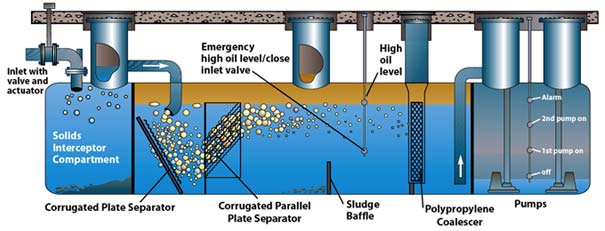
Inlet and outlet piping enters the vessel through the top centerline of the
separator per UL-58 requirements. This assures that the separator always operates full of
liquid, thus utilizing the total volume of the vessel.
back to illustration
|
 |
Flow
is directed towards a single corrugated plate at an angle perpendicular to the entrance
pipe. This method of separation, known as the Buffalo-Morse Principle, serves multiple
functions.
- It reduces the velocity head of the incoming stream.
- It spreads the flow out over the entire cross sectional area of the separator and
prevents channeling of the flow.
- The plate corrugations create sinusoidal flow patterns, which cause solids to
break out of the flow stream and oil droplets to collide and coalesce.
back to illustration
|
 |
The second stage of separation in the PSI separator is based upon the
proven Royal Dutch Shell Principle of using multiple corrugated parallel plates. The
parallel plate pack in the PSI oil-water separator consists of a special arrangement of
heavy gauge removable corrugated steel plates. The plates are inclined at a 45 degree
angle to prevent the accumulation of solids and the plate spacing is large enough to
prevent plugging from debris and trash. An open area is located directly below the plate
frame to prevent the accumulation of solids in front of the plate pack.
The plate pack provides a crucial role in separation so it is vital
that this pack is located in the front end of the vessel in order to maximize the
effective separation chamber of the separator. This is the case in the PSI design.
back to illustration
|
 |
The internal sludge baffle in the PSI separator serves two primary functions.
First, solids are carried downstream in the separator by the internal hydraulics of the
vessel where they collect in front of the sludge baffle. The baffle is located directly
below the access manway for easy sludge removal from grade. Second, the sludge baffle
directs the flow from the bottom quadrant of the separator towards the top of the vessel
aiding in the floatation of small oil particles in the flow stream.
back to illustration
|
 |
PSI can provide, as an option, an aditional polypropylene coalescer. This
consists of a special matrix of polypropylene fibers designed to coalesce oil droplets
down to 20 microns in size. An important addition to the PSI separator design is the use
of a large coalescer access manway that spans the entire cross section of coalescer and
includes dedicated tracks for the coalescer. This ensures easy removal and reinstallation
of the coalescer from grade. Other separators require maintenance personnel to "fish"
their polypropylene coalescer out in pieces through a small access manway. These designs
make it difficult if not impossible to reinstall the coalescers without draining and
entering the vessel.
back to illustration
|
 |
The
outlet pipe is located at the end of the separator and draws clean water from the most
quiescent section of the vessel. The effluent will contain a free oil and grease discharge
of no more than 15 ppm in PS and PSR model separators and no more
than 10 ppm in PSC and PSRC model separators.
back to illustration |
 |
PSI has the experience to provide solid state control systems to meet a wide
variety of fluid level monitoring and flow control requirements including intrinsically
safe liquid level sensors and custom-built control panels. Installing a high performance
PSI separator to meet your discharge requirements along with a maintenance warning system
will alleviate your wastewater treatment worries.
back to illustration |